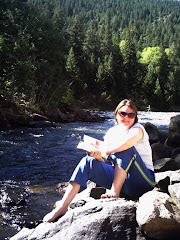
With the slower pace of summer, I'm actually able to do what I love--read. So far, I've devoured three books: Fanny Flagg's
Can't Wait to Get to Heaven, Elisabeth Robinson's
The True and Outstanding Adventures of the Hunt Sisters, and Troost's
The Sex Lives of Cannibals.
 Can't Wait to Get to Heaven
 guarantee's laughs, and at the end of the school year that's exactly what I needed. Though, I've never read
Fried Green Tomatoes at the Whistle Stop Cafe, I have read
Daisy Fay and the Miracle Man by Flagg. There's a sense of "going home" when I read Flagg's stories. The idea of the South and the acceptance of flaws. Or maybe the going home feeling ties in with the close-knit families, who love and accept each other flaws and all.
Early in the novel, Flagg describes the nervous niece Norma, who cares for her elderly Aunt Elner, who has just fallen off a ladder after being attacked by wasps while trying to pick figs.
She had an earthquake kit in the garage, where she kept bottled water, matches, six cans of Del Monte chili, a small supply of her hormones, thyroid medicine, aspirin, a jar of Merle Norman cold cream, and fingernail polish remover, and an extra pair of earrings. Although it was not very likely that an earthquake would hit Elmwood Springs, Missouri, she felt it was better to be safe than sorry.
I laughed out loud reading this. We all know someone who's ready for a disaster. But, look at the things she feels are necessary to ride out a disaster. As I write this, I wonder what would be in my earthquake kit. Maybe I'll explore that later.
Of course, in the end, there's the twist, with the deep, haunting secret, but there are plenty of laughs along the way.

I picked up both
Can't Wait to Get to Heaven and
The True and Outstanding Adventures of the Hunt Sisters from the clearance rack at Half-Price Books. Robinson's novel is written in the form of one sister, Olivia's, correspondence during the other sister, Madeline's struggle with leukemia. Part of the novel seems unreal to me because it seems no one writes letters the way Olivia does. There are a few emails and faxes added in to update the book, but as I read the letters she writes, the feeling kept tugging at me that we don't write like that anymore. I try from time-to-time to send real, handwritten letters, but with email, it seems that's how I'm more apt to correspond.
The story is beautifully written and revealed in the correspondence to various people in Oliva's life and is paralleled nicely to
Don Quixote, a movie Olivia is trying to produce during her sister's illness. When all is finished, it is easy to see that Maddie is Don Quixote and Olivia is Sancho.

This is absolutely not a book I would have chosen on my own, but a reader-friend, Kelly, loaned it to me. And I LOVED it. While the title is a bit deceiving (really, there are only 1-2 brief mentions of sex in the book), it is a great non-fiction travel journal. Troost and his girlfriend end up living in the Pacific on a small island called Tarawa in the Kiribati Islands. (Yes, I had to get the Atlas out to find it.)
Marteen and Sylvia move to Tarawa and live there for two years. Living on the island, where electricity is intermittent at times, where there is no air conditioning, where life moves at a different pace, allows Marteen experiences most of us will never have: fishing with just a piece of line, a hook, and bare hands to pull in a 25-lb. yellow fin tuna; catching dinner for each night's meal; body surfing.
There's a part of me that would love to leave everything behind and head to a remote place like this, but then I wonder how many of my creature comforts I could give up. Maybe it's best that I live vicariously through Troost. Sometimes it is nice to dream about living at the end of the world.
And, now, I have to choose my next book from my stack of summer reading. Will it be War and Peace, The Other Boleyn Girl, or something fun and entertaining? We'll see.
 A schooner in the harbor.
 Letha gets ready to make a photo.
 Eagle Lake
 The top of Cadillac Mountain.
 More of the rugged landscape.


 Miranda poses.